
Why Your Melatonin Gummies Aren't Working (and What to Try Instead)
You did the responsible thing. You skipped the sleeping pills, bought the cheerful bottle of melatonin gummies, took two before bed like the label said — and lay there awake anyway, wondering if you're broken or the bottle is.
Neither. You've just met the most misunderstood molecule in the sleep aisle: a perfectly real hormone, sold in the wrong dose, at the wrong time, for the wrong job — and, in the case of gummies, often not even in the stated amount.
What melatonin actually is (and isn't)
Melatonin is not a sedative. It's a clock signal — the hormone your brain releases when darkness falls, announcing to the body that biological night has begun. Taking it doesn't knock you out the way a sleeping pill does; it tells your internal clock "night starts now." That distinction explains everything:
- For circadian problems — jet lag, shift work, a body clock that runs late — shifting the clock is exactly what you need, and melatonin has real evidence. This is where it shines.
- For ordinary insomnia — stress, racing mind, conditioned wakefulness — your clock isn't the problem, so a clock signal barely helps. The standard meta-analysis (Ferracioli-Oda et al., 2013) finds melatonin speeds sleep onset by about seven minutes on average. Real, but modest — nobody's insomnia is seven minutes wide.
Melatonin is a clock instruction, not an off switch. If your clock isn't the problem, the instruction changes almost nothing.
The gummy problem, specifically
It gets worse for the gummy bottle. When researchers lab-tested melatonin supplements (Erland & Saxena, 2017, Journal of Clinical Sleep Medicine), actual content ranged from 83% less to 478% more than the label claimed — and gummies were among the least reliable formats, with batch-to-batch swings inside the same brand. Some products also contained unlisted serotonin. Supplements aren't regulated like medicines; the cheerful label is a suggestion.
Then there's the dose. Store shelves push 5 and 10 mg because bigger numbers sell — but research on circadian shifting repeatedly finds 0.5–1 mg works as well or better. Physiological night-time melatonin is measured in tenths of a milligram; a 10 mg gummy is a shout where the body whispers, lingers into the morning (hello, grogginess), and in some people lands the signal at the wrong clock phase entirely.
Using it right — or skipping it honestly
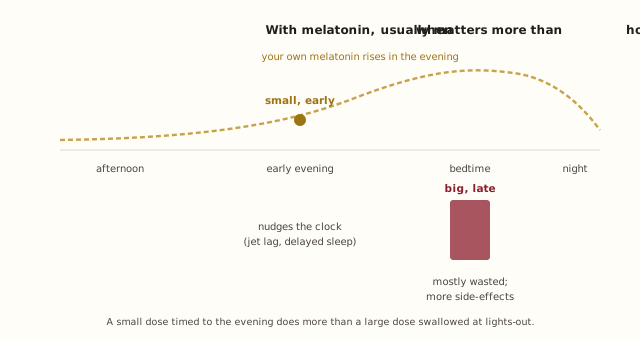
The honest protocol
- Right jobs: jet lag, shift rotation, a chronically late body clock (the night-owl teenager, the midnight-brain adult). Wrong job: stress insomnia, 3 a.m. wake-ups, a racing mind.
- Right dose: 0.5–1 mg. More isn't stronger; it's just longer and groggier.
- Right time: 2–3 hours before the bedtime you're aiming for — paired with dim evening light, or you're pressing the accelerator and brake at once.
- Right product: tablets from brands with third-party testing (USP/NSF marks) over gummies. Boring beats delicious here.
- Talk to a doctor first if you're pregnant, on blood thinners or immunosuppressants, or giving it to a child — "natural" isn't "neutral."
What to try instead
If gummies disappointed you, the fix usually isn't a different bottle. The best-evidenced sleep aids are unglamorous: a consistent wake time, a real wind-down, an honest caffeine cutoff, a cool dark room, and — for chronic insomnia — the behavioral program (CBT-I) that outperforms every pill tested against it. The supplement aisle promises sleep in a bottle. The evidence keeps pointing back at the routine.
Educational content — not medical advice. Every Sleep Solutions volume includes a "When to See a Professional" chapter; if your sleep problem comes with warning signs (gasping, chest pain, severe daytime impairment), talk to a clinician.