What Time Should You Stop Drinking Coffee? The Caffeine Half-Life Math
Somewhere between the 2 p.m. slump and the 6 p.m. commute, most of us make a small decision — one more coffee won't hurt — that quietly taxes the night ahead. Not dramatically. You'll still fall asleep. But the sleep you get will be lighter, shallower, and less restorative than the sleep you paid for.
The reason is a number most coffee drinkers have never been told: caffeine's half-life is five to six hours.
The half-life math, in plain terms
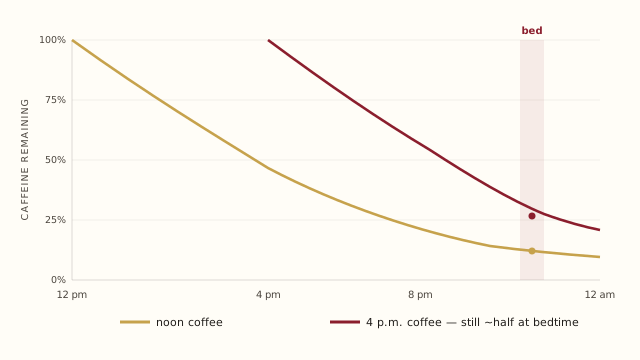
Half-life means the time your body needs to eliminate half of a dose. Say you drink a 200 mg coffee at 4 p.m. (a large brewed cup or a flat white with an extra shot):
- At 10 p.m. — ~100 mg is still circulating. That's a full espresso in your bloodstream as you brush your teeth.
- At 4 a.m. — ~50 mg remains. A quarter of your afternoon coffee is still on duty in the hours your deep sleep is supposed to happen.
The landmark study here is refreshingly blunt: researchers gave people 400 mg of caffeine at bedtime, 3 hours before, or 6 hours before bed — and even the 6-hour group lost more than an hour of measured sleep, without noticing it themselves (Drake et al., 2013, Journal of Clinical Sleep Medicine). That last clause is the trap: caffeine steals sleep quietly. You don't lie awake; you just sleep worse and wake up wondering why you need more coffee.
Caffeine doesn't add energy. It borrows it from tonight — at interest.
So what's the cutoff?
The honest answer: it's personal, because half-life varies enormously — from about 2 hours in fast metabolizers to 10 or more in slow ones. Genetics (the CYP1A2 liver enzyme), pregnancy, some medications and even oral contraceptives all slow clearance down. But the working rules are simple:
Find your caffeine cutoff
- Default rule: no caffeine within 8–10 hours of bed. Sleep at 11 p.m.? Last coffee between 1 and 3 p.m.
- Sleeping badly anyway? Pull the cutoff to noon for two weeks. It's the cheapest sleep experiment you will ever run.
- Count everything: tea (~50 mg), cola (~40 mg), dark chocolate (~25 mg/bar), pre-workout powders (often 150–300 mg!), and "decaf" (2–15 mg — it's decaf, not nocaf).
- Don't quit — time it. Morning caffeine is fine for almost everyone. This is about the clock, not the habit.
The vicious cycle worth naming
Bad night → heavier caffeine use the next day → later, larger doses → lighter sleep → worse morning → more caffeine. Most people treat the morning symptom and feed the evening cause. Move the cutoff earlier and the loop runs in reverse: better nights need less rescuing.
And if your problem isn't falling asleep but waking at 3 a.m., caffeine is still a suspect — late doses specifically thin out the second half of the night. (That pattern has its own playbook: see why you wake at 3 a.m..)
Educational content — not medical advice. Every Sleep Solutions volume includes a "When to See a Professional" chapter; if your sleep problem comes with warning signs (gasping, chest pain, severe daytime impairment), talk to a clinician.