Does a Nightcap Help You Sleep? Why Alcohol Backfires After Midnight
The nightcap has better branding than any pill: centuries of tradition, a warm glow, and the undeniable fact that it works — you drink it, you get drowsy, you're out in minutes. Which is exactly why it's the most successful impostor in sleep. Because what alcohol gives you isn't sleep. It's sedation wearing sleep's clothes, and it leaves halfway through the night.
The two halves of an alcohol night
Alcohol is a central nervous system depressant. In the first hours it suppresses arousal so effectively that you fall asleep faster and deeper than usual — the part everyone remembers and the reason the myth survives. Then, three to four hours in, two things happen at once: your liver finishes clearing the alcohol, and your brain rebounds — arousal systems bounce back above baseline, like a spring released.
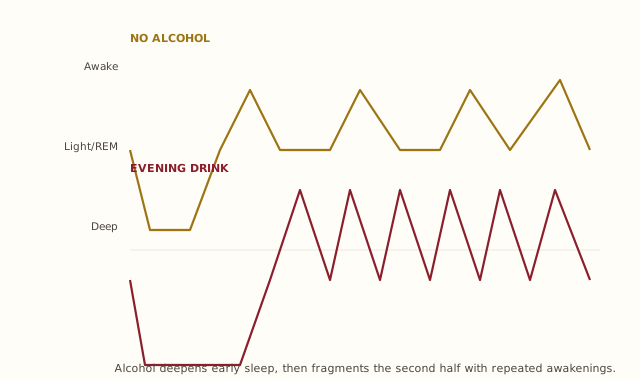
The research is unusually consistent (the standard review is Ebrahim et al., 2013): alcohol before bed shortens time-to-sleep, deepens the first half, and dismantles the second — suppressing REM (the mentally restorative stage), fragmenting the early morning hours, and adding awakenings precisely when your sleep is lightest anyway. Add its diuretic effect and the odds of a 3:30 bathroom-and-then- wide-awake sequence climb further.
Alcohol doesn't help you sleep. It helps you lose consciousness — and bills the second half of your night for the service.
"But it works for me"
It genuinely feels that way, for two reasons. First, you're asleep during the damage — you remember the easy drop-off, not the shallow 4 a.m. Second, tolerance: use a nightcap nightly and the sedation fades within days, so the dose creeps up while the rebound stays. The end state is the worst of both: needing a drink to fall asleep, and sleeping badly anyway. If you wake at 3 a.m. more nights than not, and there's wine with dinner or whisky after, the experiment runs itself — two weeks dry in the evenings, watch what happens. (More on the 3 a.m. mechanics here.)
Drinking without donating your night
The harm-reduction rules
- Finish 3–4 hours before bed. One glass of wine takes roughly 2 hours to clear; give the rebound time to happen before lights-out, not during your REM.
- Earlier > less, less > neither. A 7 p.m. glass beats a 10 p.m. glass more than one glass beats two.
- Water alongside — blunts the diuretic wake-up call.
- Never as a sleep aid. Social drinking is one thing; medicinal nightcaps are a dependency with a rebound problem. If you can't fall asleep without one, that's the actual problem to fix — and it's very fixable.
- Snorer in the bed? Evening alcohol relaxes throat muscles and turns snorers into chainsaws. The cutoff helps both of you.
The honest verdict: alcohol is the only popular "sleep aid" that reliably makes sleep worse in direct proportion to how well it seems to work. Enjoy the glass for what it is. Just stop asking it to do a job it was never doing.
Educational content — not medical advice. Every Sleep Solutions volume includes a "When to See a Professional" chapter; if your sleep problem comes with warning signs (gasping, chest pain, severe daytime impairment), talk to a clinician.