A practical, evidence-informed guide for parents of children aged 2 to 7 who hit, kick, bite, shove or play far too rough. No yelling, no physical punishment, no psychology lectures.
"I've separated them three times and it isn't eight in the morning yet."
And at night, when he finally falls asleep, you're left with a question bigger than all the rest: is he going to be a violent adult? This book answers that in the first chapter, with data. Then it spends 100 pages on what you actually need: what to do with your hands, your face and your mouth the next time he hits you.
Before any technique, one fact almost no parent has heard.
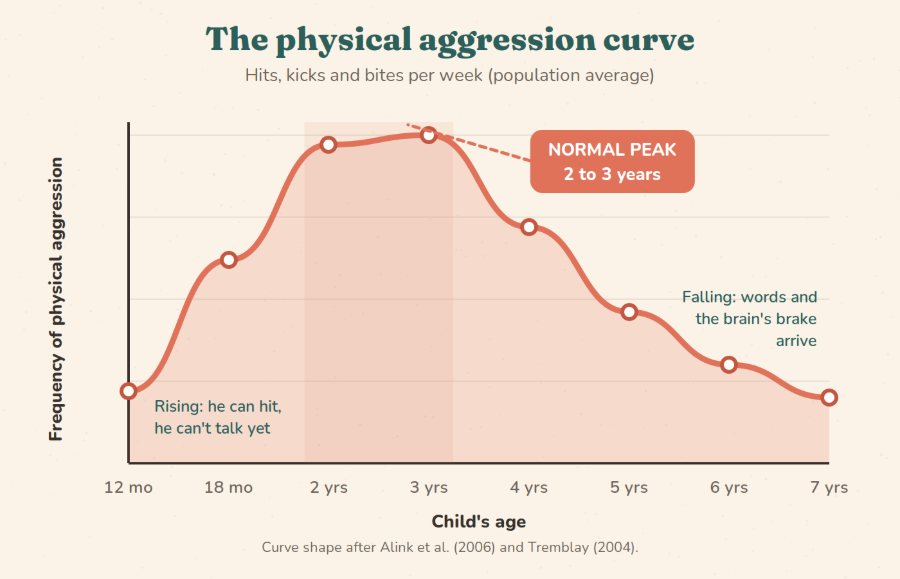
It starts at age two. And at age two it is at the highest point it will ever reach. Studies following thousands of children find the same curve every time: it rises through the second year of life and declines from the third birthday onward.
Your child is not a future aggressor — he's at the normal peak of a curve. What you can change is how long it lasts, how far it escalates, and what he learns along the way. That's what this book is about.
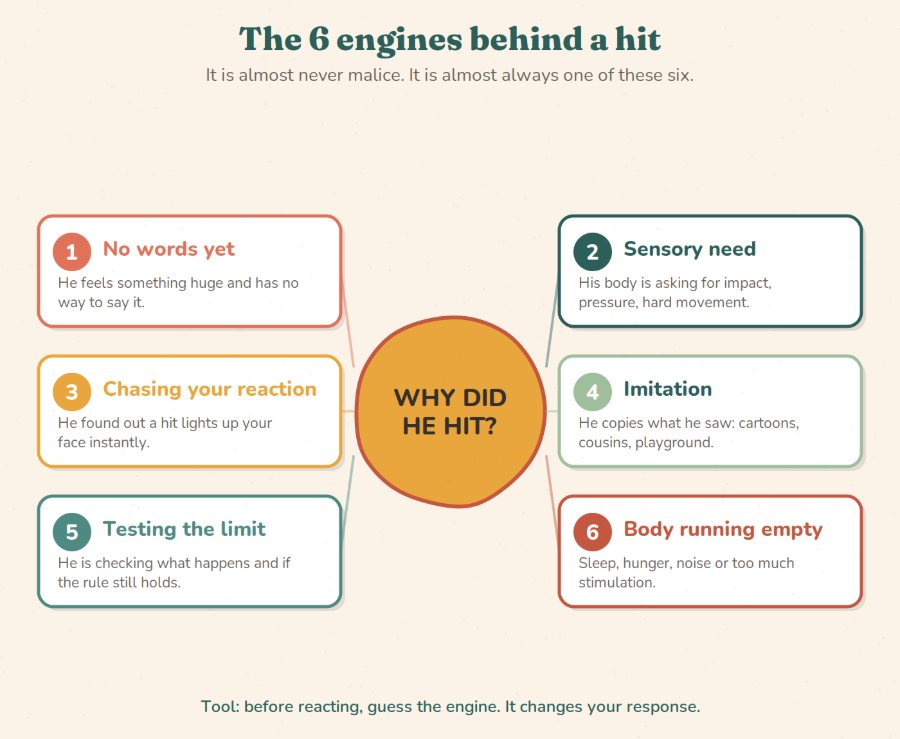
Tiredness, hunger, sensory overload, frustration without words, attention, and limits that shift depending on the adult. It's almost never "being bad" — it's a state.
The book teaches you to spot your child's main engine with three days of logging, and why fixing the state prevents the hit far better than punishing it afterwards.
One download, all of it usable this week.
102 pages in EPUB and PDF. Read it on your phone, your Kindle, or print it.
Each with the exact script, the steps, and the common mistakes.
Word for word — including the time the one who lost control was you.
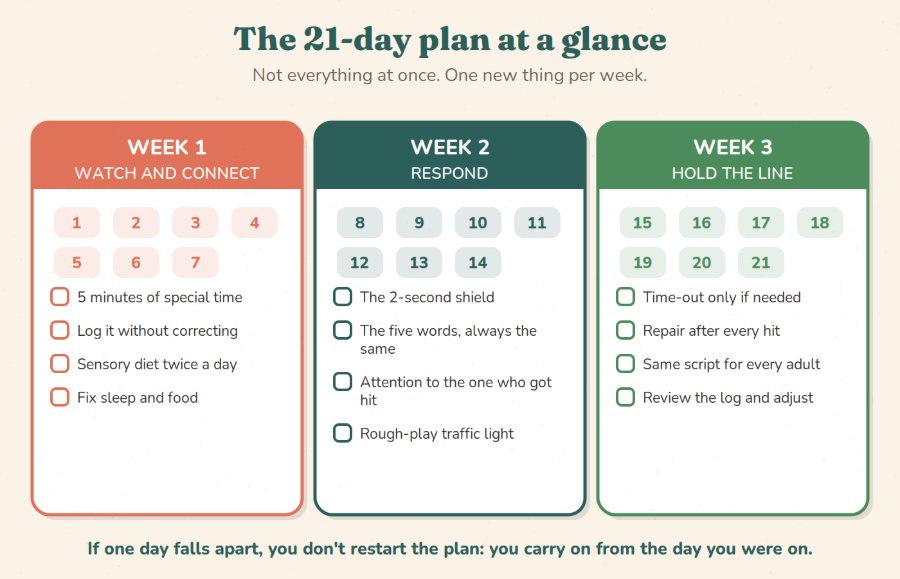
One new task per week and three reviews. No changing everything on Monday.
To understand fast — and to show the relative who keeps recommending "a firm hand".
The fridge sheet, the hit log, and the pocket cards.
Manos Suaves included in EPUB and PDF, at no extra cost.
All of them work at home, today, with nothing to buy.
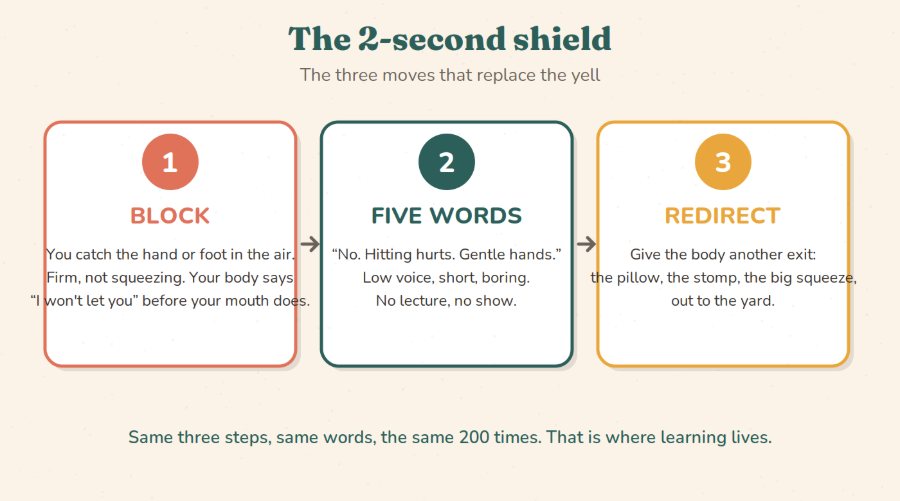
Block the arm without squeezing, say the five words with a still face, and redirect the energy somewhere else. Two seconds, always in the same order, always the same.
It's the first thing you learn because it's what makes the rest of the book work: your reaction stops being a lottery.
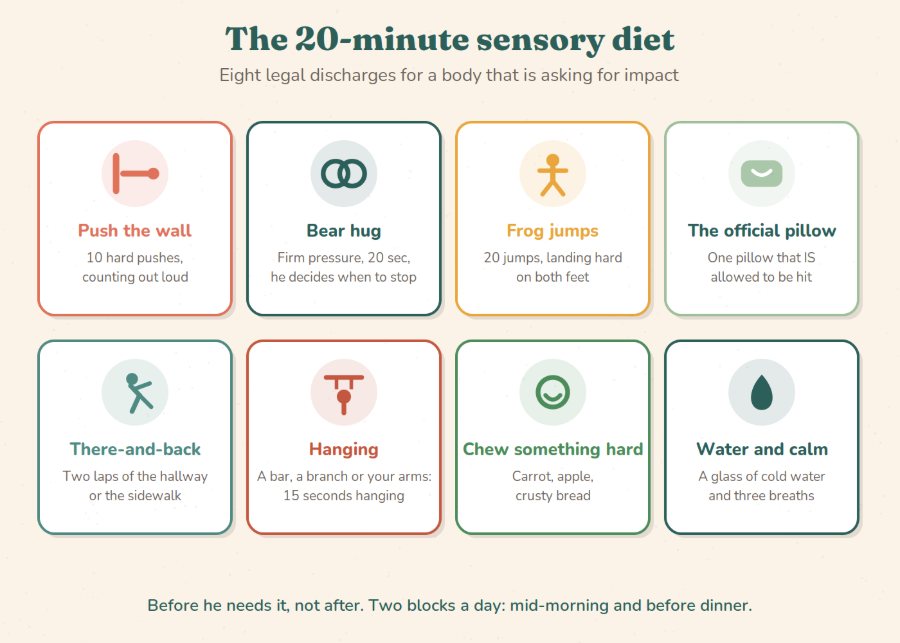
Some children don't hit out of anger: they hit because their body is asking for input and gets it by crashing into people. Twenty minutes of the right discharge brings the hitting down faster than any consequence.
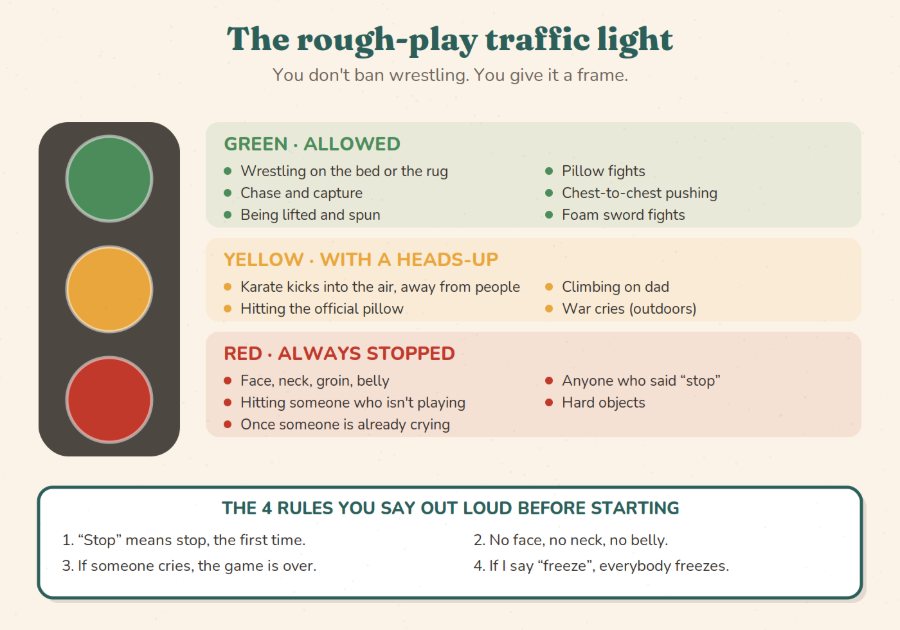
Banning wrestling usually makes things worse and takes away one of the best emotion-regulation workouts a child gets. What works is a traffic light, four rules said out loud, and a stop signal both of you respect.
Not "set loving boundaries". The exact sentence, in the exact order.
Three weeks, one new task per week, three reviews.
Most households see a visible change in frequency between day 12 and day 18. And there's something the plan warns you about before it happens: between day 4 and day 6 it usually gets worse. That's a good sign, it's explained, and it's the week almost everyone quits.
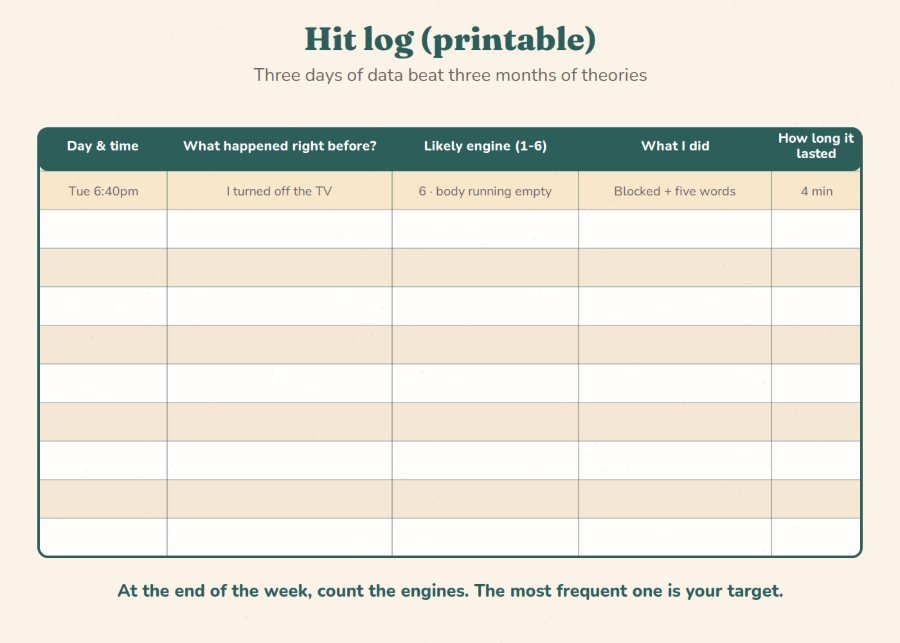
The hit log records the time, what happened right before, and which of the six engines it was. Three days in, you'll see a pattern you've been missing for months.
The printable kit also includes the fridge sheet — so every adult in the house responds the same way without reading 100 pages — the rough-play poster, and six pocket cards to cut out.
Better to know before you pay than after.
Every important claim is sourced, with full references at the end: the developmental curve of physical aggression, the relationship between language and aggression, which components of parenting programmes actually work, play fighting and emotion regulation, and time-out done properly.
And nobody gets blamed. Not you for yelling on Tuesday, not him for hitting on Wednesday.
Both include the complete book in English and Spanish, in EPUB and PDF.
30-day guarantee. If you applied the tools and the book didn't help, email us within 30 days and we'll refund 100%. No awkward questions, and you keep the files.
Both. Whichever version you buy, you get Gentle Hands in English and Manos Suaves in Spanish, each in EPUB and PDF, at no extra cost. DRM-free: reads on phone, tablet, desktop and Kindle.
Much of it, yes: the shield, the five words, differential attention and repair all keep working. But the book is calibrated for ages 2 to 7, and from 8 onward there are themes (peer groups, older siblings, screens) it doesn't cover in depth.
Yes, there's a specific chapter. And that difference between settings is actually good news: it usually points to a situational problem, not a problem with the child.
It's practical before it's doctrinal. There are firm limits and there are consequences — and there is zero physical punishment and zero humiliation. If those two things sound compatible to you, this book is for you.
Yes, with five concrete steps and a lot of conditions. The chapter explains what the available evidence says and why the badly done version — yelled, long, shaming — is the one to avoid.
There's a one-page fridge sheet designed for exactly that: the sentence, the three steps and the rough-play rules, so any adult in the house can respond the same way without reading 100 pages.
No, and the book says so explicitly. There's a chapter with concrete warning signs, what kind of professional to look for, and the five questions worth taking to the first appointment.
The plan is 21 days. Most households see a visible change in frequency between day 12 and day 18. It's normal for things to get worse between day 4 and day 6, and the book explains why.
Instantly. Checkout runs through Gumroad and you get the download link straight away — no waiting, no shipping.
Block, five words, redirect. Two seconds. And 100 more pages for everything else.