Night Owl + Early Bird: How Couples With Opposite Sleep Schedules Survive
One of you starts yawning at 9:30 and is gone by 10. The other finally feels awake at 10, does their best thinking at midnight, and considers 7 a.m. a hostile act. Every couple negotiation you've tried — "just come to bed earlier," "just stay up a bit" — has failed, and each of you privately suspects the other isn't really trying.
Here's the peace treaty, and it starts with biology: neither of you is doing this on purpose.
Chronotypes are genetics, not character
Your chronotype — where your body clock naturally places sleep — is substantially heritable, written in clock genes (PER and friends) and expressed in hard physiology: the night owl's melatonin release and core-temperature minimum sit hours later than the lark's. Asking a true owl to feel sleepy at 10 p.m. is asking them to feel sleepy at what their body registers as 8. It's not laziness; it's time-zone difference between two people sharing one bed. Researchers call the strain of living against your chronotype social jetlag — and a mismatched couple imposes it on each other nightly.
You're not incompatible. You're in different time zones, sleeping in the same room.
What doesn't work
- Conversion therapy. The owl who forces 10 p.m. bedtimes lies awake (building insomnia associations); the lark who forces midnight is a zombie by Thursday. Chronotype can be nudged — mostly with morning light — but not replaced.
- The resentment ledger. "You never come to bed with me" vs. "you always wake me at dawn." Both true, neither anyone's fault, and the scorekeeping costs more sleep than the mismatch.
- Synchronized suffering. Two people going to bed at a compromise time that suits neither is the worst of all schedules.
What works: shared evening, separate bedtimes
The mismatch playbook
- Wind down together, sleep on your own clocks. The intimacy most couples miss isn't simultaneous unconsciousness — it's the 30–60 minutes before. Share that (screens off, lights low, in bed together), then the owl gets up quietly for round two of their evening.
- The owl enters like a burglar. Clothes laid out, teeth brushed in the other bathroom, phone-flashlight, no duvet excavation. Most lark complaints are re-entry complaints, and re-entry is a solvable logistics problem.
- The lark exits like one too. Alarm on vibration under the pillow (or a wearable), clothes outside the room, coffee machine — not in the bedroom conversation at 6:15.
- Protect the anchors. Each of you keeps a consistent wake time — the single strongest stabilizer of any schedule. The owl's worst enemy is the weekend drift that resets Monday to jetlag.
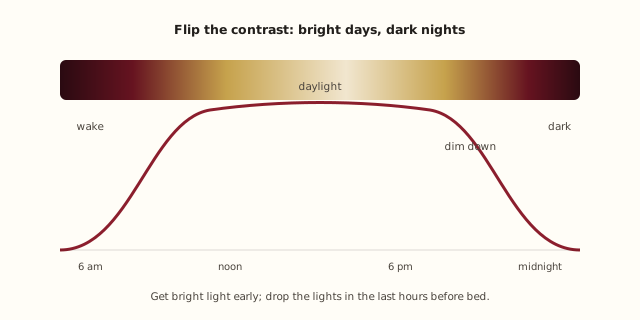
- Morning light for the owl — 10–20 minutes outdoors soon after waking gently pulls a late clock earlier, over weeks. It's the only "conversion" with evidence.
- Blackout + masking so the first riser's dawn and the late sleeper's lamp stop being shared events. Two duvets while you're at it.
The intimacy accounting
Couples who handle this well do one honest thing: they stop measuring closeness in overlapping unconscious hours and start scheduling the waking kind — the shared wind-down, the weekend morning when the owl is finally, gloriously in phase. And if the mismatch is compounded by snoring or a duvet war, separate beds done right beats a shared bed done resentfully, every time.
Two people on their own clocks, each well-slept, meeting on purpose — that's not a compromise. That's the fix.
Educational content — not medical advice. Every Sleep Solutions volume includes a "When to See a Professional" chapter; if your sleep problem comes with warning signs (gasping, chest pain, severe daytime impairment), talk to a clinician.